Thermoplastic Polymers and Wire Mechanics: A Structural Engineering Analysis of Retainers After Braces

Welcome to this technical brief for SmileNote. The efficacy of post-orthodontic retention is fundamentally a problem of materials science and mechanical engineering. The device must withstand the cyclic fatigue of occlusion, the corrosive environment of the oral cavity, and the hydrolytic degradation of polymers, all while exerting a passive retaining force on the dentition. The terminology "retainers after braces" encompasses a variety of device architectures, primarily categorized into vacuum-formed thermoplastics (VFRs) and wire-acrylic composites. This analysis deconstructs the physical properties, stress-strain behaviors, and failure modes of these retention systems.
Vacuum-Formed Retainers (VFRs): Material Properties
The ubiquitous "clear retainer" (e.g., Essix) relies on the thermoforming of copolyester or polyurethane sheets over a dental cast.
Polymer Chain Orientation and Stress Relaxation
During the thermoforming process, the plastic sheet is heated to its glass transition temperature (Tg) and drawn over the model via vacuum suction. This process orients the polymer chains. Upon cooling, the material locks into a rigid shape. However, thermoplastics are viscoelastic materials. Over time, they undergo "stress relaxation," where the internal stress decreases under constant strain. Clinically, this means the retainer loses its "grip" or retentive force as the polymer chains slowly reorganize. Furthermore, the occlusal forces cause "creep"—permanent deformation of the material. When determining how long do you wear retainers after braces before requiring a replacement, one must consider that technical audits of these devices fabricated from copolyester show a statistically significant reduction in retentive modulus after 6 months of in vivo use, necessitating periodic replacement to maintain vector fidelity.
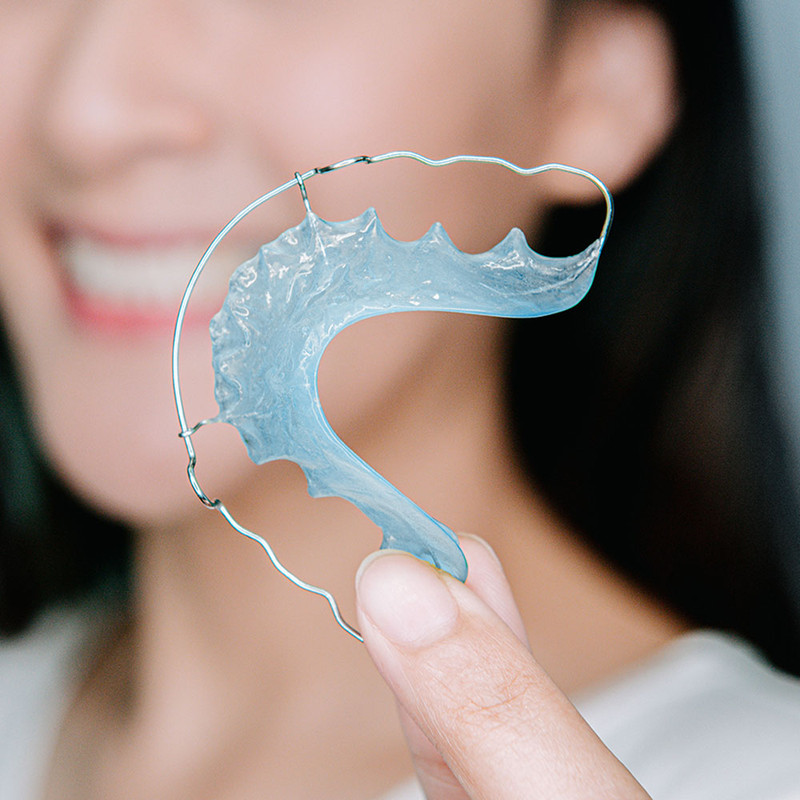
The Hawley Retainer: Wire Mechanics and Acrylic Polymerization
The Hawley retainer utilizes a stainless steel labial bow embedded in a polymethyl methacrylate (PMMA) base.
Tensile Strength and Modulus of Elasticity
The labial bow is typically fabricated from 0.030 or 0.032-inch stainless steel wire. Stainless steel is selected for its high modulus of elasticity (E ≈ 200 GPa) and yield strength. This allows the wire to act as a rigid fence against labial drift. Unlike the VFR, which covers the occlusal table, the Hawley engages the undercuts of the molars via Adams clasps or ball clasps. The PMMA base acts as an anchorage unit. The interface between the wire and the acrylic is a critical stress concentration point. Fatigue failure often occurs here due to the cyclic flexing of the wire during insertion and removal. However, the mechanical advantage of the Hawley in the context of retainers after braces lies in its adjustability; the loops in the canine region allow for the mechanical alteration of the wire's active length and force vector, permitting minor tooth movement capability that static VFRs lack.
Bonded Lingual Retainers: Adhesive Failure Modes
Fixed retention involves a multi-strand twisted wire bonded to the lingual surfaces of the anterior teeth.
Composite Resin Interface and Shear Bond Strength
The wire (usually 0.0195-inch or 0.0215-inch multi-strand steel) is passive. The critical engineering challenge is the bond interface. The wire is bonded using a flowable composite resin. The shear bond strength required to resist masticatory forces must exceed 20 MPa. However, the "peel" forces exerted during biting are destructive. The failure mode is typically adhesive (between resin and wire) or cohesive (within the resin). A common technical failure in fixed retainers after braces is the fracture of a single bond pad while others remain intact. This creates a pivot point. The wire, still attached to adjacent teeth, allows the unbonded tooth to rotate around the wire axis, creating a complex vector of torque that can rapidly displace the tooth undetected.
Wear Resistance and Hydrolytic Degradation
The oral environment is chemically hostile.
Hygroscopic Expansion
Acrylics and polyurethanes absorb water (hygroscopic expansion). In VFRs, this absorption can lead to plasticization, lowering the material's stiffness. In Hawley retainers, water sorption can cause slight dimensional changes in the acrylic base. Furthermore, the abrasion resistance of VFR materials is lower than enamel. Bruxism (grinding) results in rapid occlusal perforation of the thermoplastic. From an engineering standpoint, patients with heavy occlusal forces are mechanically contraindicated for VFR retainers after braces unless constructed from thicker, more rigid polyurethane materials specifically engineered for wear resistance.
The engineering selection of a retention device requires balancing the viscoelastic limitations of thermoplastics against the mechanical rigidity and adjustability of steel-acrylic composites. Both systems present distinct fatigue lifecycles. Understanding the material science behind retainers after braces allows for predictable maintenance schedules and the anticipation of mechanical failure before clinical relapse occurs.